 2022, Vol. 43


肥胖是体内脂肪过度沉积引起的一种代谢综合征,已成为全球流行的公共健康问题[1]。在人类健康中,肥胖能使人体血脂异常,引发心血管疾病、癌症和降低女性生育能力[2-4]。在动物生产中,肥胖能降低动物繁殖性能、泌乳能力和产仔数[5]。因此,调控机体脂肪沉积、减少肥胖,在动物生产和人类健康中均具有重要意义。
共轭亚油酸(Conjugated linoleic acid,CLA)是含有共轭双键的亚油酸异构体混合物。其中,顺9,反11−共轭亚油酸(c9, t11-CLA)和反10,顺12−共轭亚油酸(t10, c12-CLA)为发挥生理功能的主要异构体。CLA具有减肥[6]、降脂[7]和防治糖尿病[8]等生理作用。目前研究发现CLA的减脂分子机制主要有:抑制成脂分化;诱导细胞凋亡;CLA与过氧化物酶体增殖物激活受体(Peroxisome proliferator-activated receptor,PPAR)相互作用;增加呼吸链解偶联蛋白−1 (Uncoupling protein 1, UCP-1)和肉碱−棕榈油转移酶−1 (Carnitine palmitoyltrans-ferase 1, CPT-1)的表达,促进脂肪降解[9-10]。脂肪代谢过程受多种因素影响,因此CLA对脂肪沉积的调节机制仍值得探究。
脂肪组织是机体的能量调节器。当机体能量过剩时,多余的能量以中性甘油三酯的形式储存在脂肪组织中,进而使机体肥胖[11],因此,能量代谢是调节肥胖的重要因素。肠道微生物作为日粮与机体健康之间的桥梁,与机体的脂肪含量、能量代谢和免疫功能等密切相关[12-13]。已有研究报道,肥胖小鼠体内双歧杆菌Bifidobacterium丰度降低[14];给无菌小鼠移植从肥胖人体分离出来的肠道微生物会导致无菌小鼠肥胖[15]。综上所述,能量代谢和肠道微生物均会影响机体脂肪沉积,而目前关于CLA对能量代谢和肠道微生物的影响知之甚少。
本研究通过普通日粮中添加不同CLA异构体饲喂小鼠一段时间后,对小鼠进行能量代谢检测和肠道微生物分析,探讨日粮添加不同CLA异构体对小鼠脂肪含量、能量代谢和肠道微生物的影响。研究结果可望完善共轭亚油酸减少脂肪沉积的机制,对于生产中降低脂肪过量沉积,提高生产效益,以及临床上肥胖症、糖尿病等代谢紊乱相关疾病的治疗,均具有重要意义。
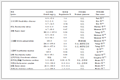
1 材料与方法 1.1 试验设计和样品采集选取24只健康状况良好的8周龄C57BL/6J雄性小鼠。预饲1周后按体质量平均且随机地分为3组,即对照组(CK)、c9, t11-CLA组和t10, c12-CLA组,分别饲喂普通日粮、普通日粮添加质量分数为2%的c9, t11-CLA或t10, c12-CLA,饲料配方见表1。c9, t11-CLA(w≥ 44%)和t10, c12-CLA(w≥ 44%)均购自武汉祥和化工有限公司。每组8个重复,单笼饲养。每周测量体质量和采食量,持续12周,试验结束时,采集小鼠血液,分离不同部位组织并称质量,收集盲肠内容物,并于−80 ℃保存。
|
表 1 饲料组成和质量分数1) Table 1 Feed composition and content |
小鼠购于广东省医学试验动物中心(广东佛山);MesoQMP23-060H型小动物体组成分析及成像NMR仪器(上海纽迈公司);CLAMS小动物新陈代谢系统(美国Sable Systems International公司)。
1.3 指标检测与方法 1.3.1 小鼠体成像及体组成检测小鼠饲喂第11周时,进行体成像和体组成检测。打开小动物体组成分析及体成像NMR仪,放入标品自检并预热30 min。
体组成检测:刺激小鼠排粪排尿后称质量,再将小鼠放入机器中,输入小鼠体质量后进行小鼠体内脂肪、肌肉和水分的检测分析。
体成像检测:根据体组成的分析结果,每组选取2只代表性小鼠,给小鼠腹腔注射100~200 μL(根据体质量适当增减)的50 g/mL水合氯醛溶液,待小鼠昏迷且不再动弹后,将小鼠放入机器中,进行小鼠体成像记录。
1.3.2 小鼠能量代谢检测小鼠饲喂第11周时,称取小鼠体质量后,将小鼠放入代谢笼中,适应24 h后,打开机器记录小鼠的耗氧量、产热量、二氧化碳产出量和呼吸交换率(Respiratory exchange rate, RER),并对数据进行统计分析。
1.3.3 小鼠肠道微生物的测序及分析用无菌管收集3组小鼠盲肠内容物,并于−80 ℃保存,随后送至北京诺禾致源科技股份有限公司进行小鼠盲肠内容物中肠道微生物的16S rRNA测序分析。
1.4 数据统计分析文中数据结果均用平均值±标准误(Mean ± SE)表示,不同组间的比较用t检验进行统计分析。所有数据分析均用Sigmaplot 14.0统计软件完成。
2 结果与分析 2.1 2种共轭亚油酸异构体对小鼠生长的影响在试验12周后,统计小鼠体质量和周平均采食量,结果(表2)显示:与对照组相比,c9, t11-CLA和t10, c12-CLA组小鼠体质量分别降低了22.79%和25.04% (P<0.05),c9, t11-CLA组和t10, c12-CLA组小鼠周平均采食量也显著降低。
|
|
表 2 2种共轭亚油酸异构体对小鼠生长的影响1) Table 2 Effects of two conjugated linoleic acid isomers on growth of mice |
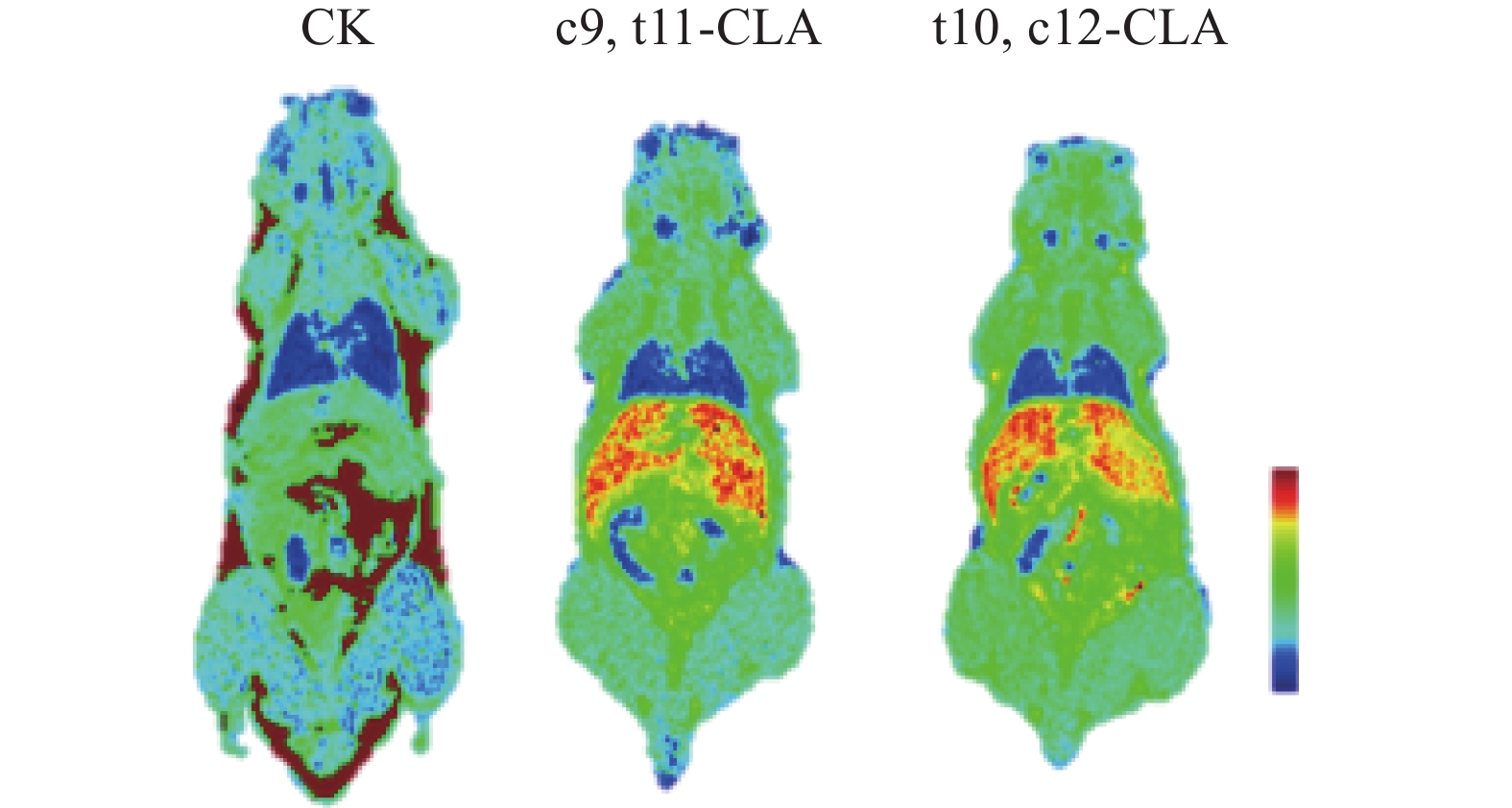
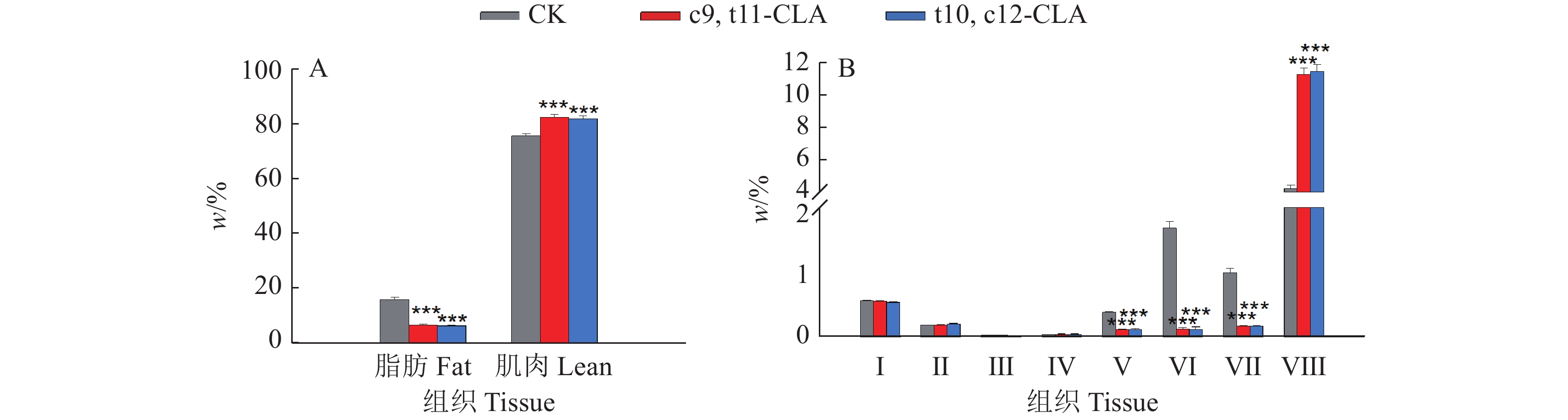
体成像和体组成结果显示,c9, t11-CLA组和t10, c12-CLA组小鼠脂肪含量分别降低了57.98%和59.41% (P<0.05) (图1、图2A);采样后小鼠不同脂肪质量与体质量的百分比统计也表明,c9, t11-CLA组和t10, c12-CLA组显著降低小鼠褐色脂肪、皮下脂肪和附睾脂肪含量(图2B)。以上结果说明,日粮添加CLA不同异构体能显著降低小鼠脂肪沉积。
|
图 1 小鼠体成像结果 Fig. 1 Body imaging results of mice |
|
图 2 2种共轭亚油酸异构体对小鼠脂肪沉积的影响 Fig. 2 Effect of two conjugated linoleic acid isomers on fat deposition in mice A为小鼠体内总脂肪和肌肉含量;B为小鼠体内不同脂肪或肌肉组织的质量与体质量的百分比,Ⅰ:腓肠肌,Ⅱ:胫骨前肌,Ⅲ:比目鱼肌,Ⅳ:趾长伸肌,Ⅴ:褐色脂肪,Ⅵ:附睾脂肪,Ⅶ:皮下脂肪,Ⅷ:肝脏;“***”表示与对照组差异达到0.001的显著水平 (t检验) A is the total fat and muscle contents in mice; B is the percentages of different fat or muscle tissue weights in the body of mice to the body weight, I: Gastrocnemius muscle, II: Tibialis anterior muscle, III: Soleus muscle, IV: Extensor digitorum longus muscle, V: Brown fat, VI: Epididymal fat, VII: Subcutaneous fat, VIII: Liver; “***” indicates significant difference from control at 0.001 level (t test) |
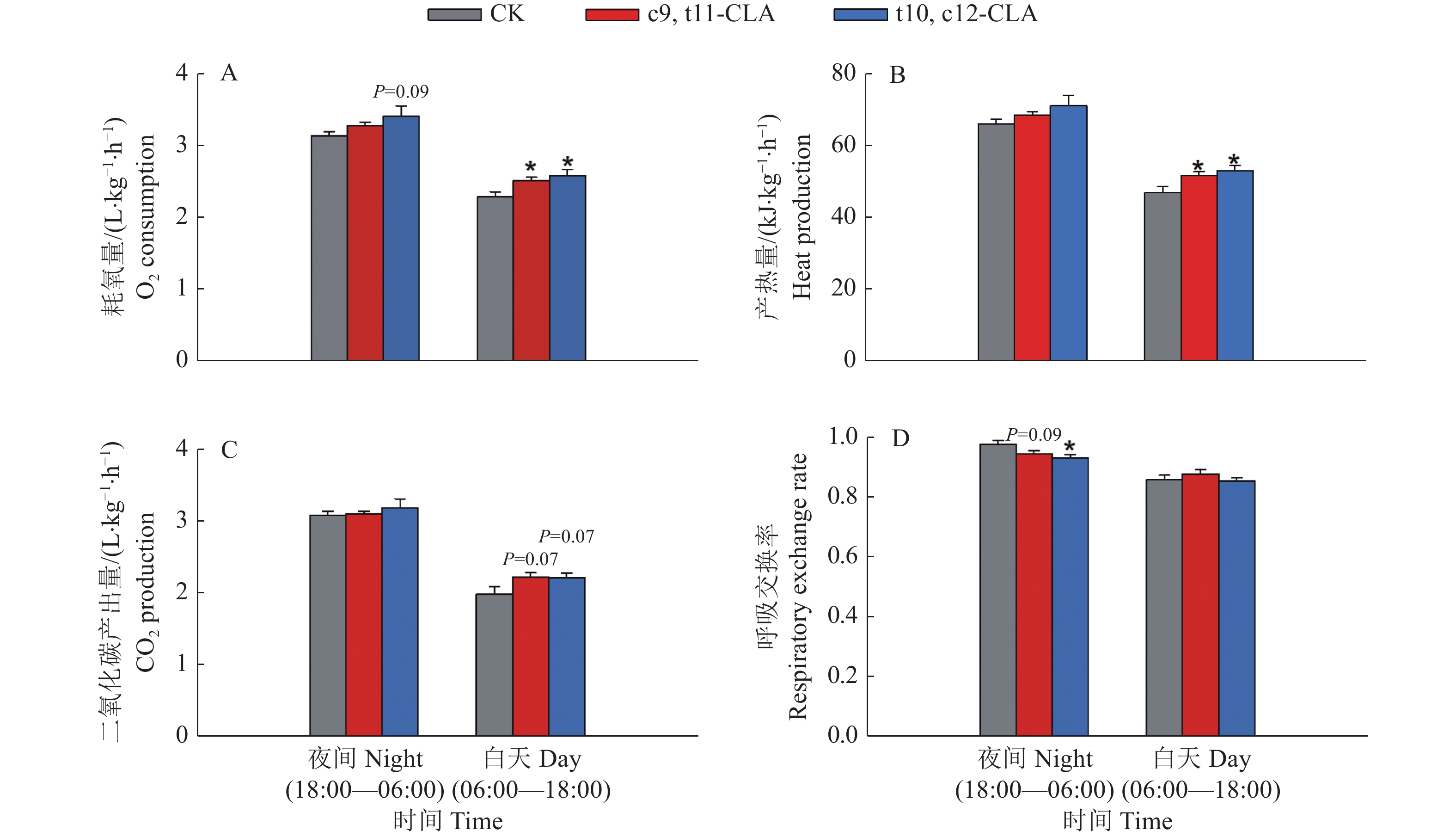
代谢笼结果显示,c9, t11-CLA组和t10, c12-CLA组均显著增加小鼠白天耗氧量(图3A)和产热量(图3B),以及有增加二氧化碳产出量的趋势(图3C),其中,t10, c12-CLA显著降低夜间RER(图3D)。以上结果表明,日粮添加CLA不同异构体能促进小鼠能量代谢,其中t10, c12-CLA促进供能物质由碳水化合物转向脂肪。
|
图 3 2种共轭亚油酸异构体对小鼠能量代谢的影响 Fig. 3 Effects of two conjugated linoleic acid isomers on energy metabolism in mice “*”表示与对照组差异达到0.05的显著水平(t检验) “*” indicates significant difference from control at 0.05 level (t test) |
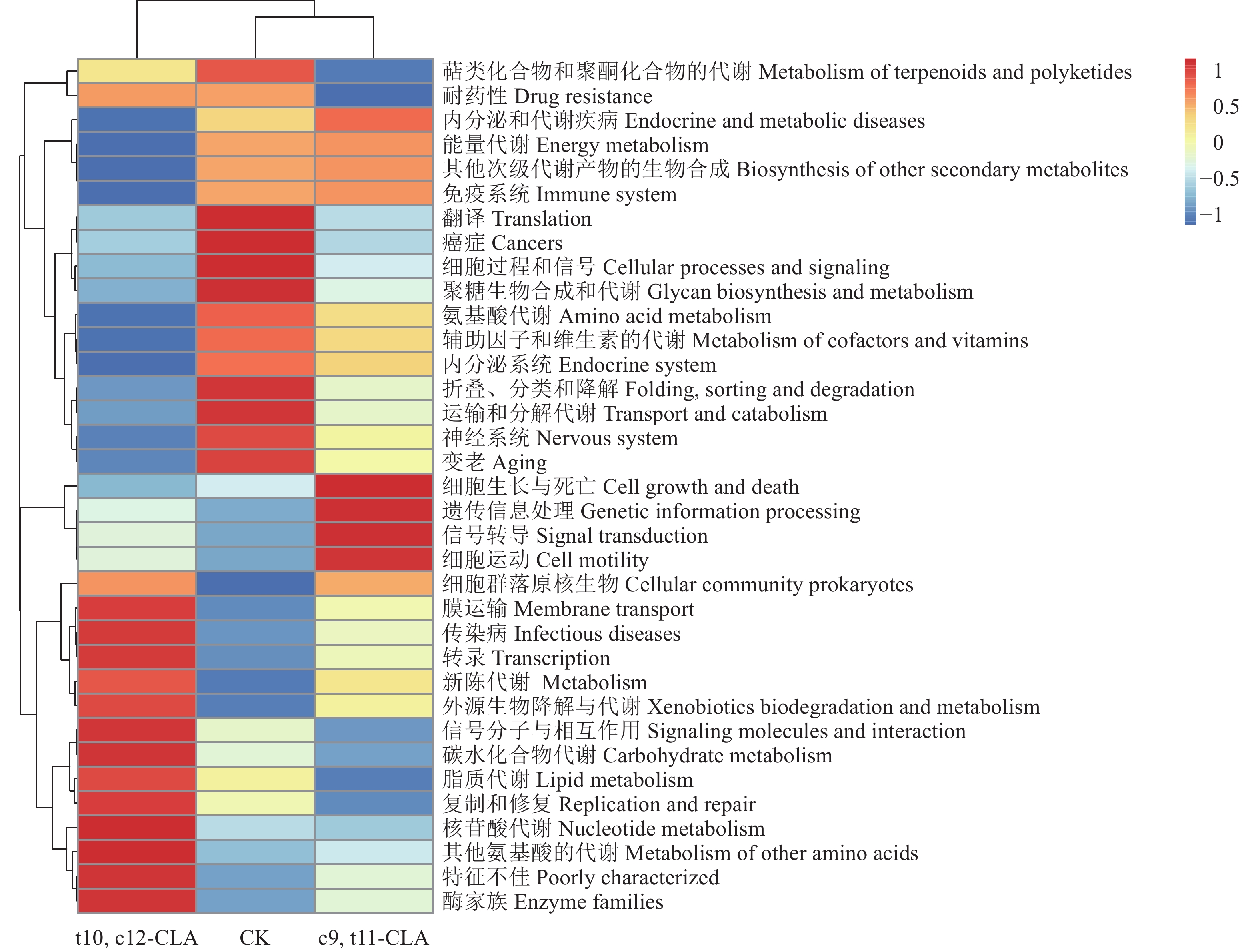
肠道微生物16S rRNA生物信息分析中,PCA结果显示,对照组和2种CLA异构体组小鼠的肠道微生物菌群结构存在明显差异(图4)。功能相对丰度聚类分析结果表明,c9, t11-CLA和t10, c12-CLA均能促进与新陈代谢相关的菌群丰度,且t10, c12-CLA能促进与脂质代谢相关的菌群丰度(图5)。

|
图 4 2种共轭亚油酸异构体对小鼠肠道微生物主成分的影响 Fig. 4 Effects of two conjugated linoleic acid isomers on the principal components of gut microflora in mice |
|
图 5 聚类分析2种共轭亚油酸异构体对小鼠功能性肠道微生物相对丰度的影响 Fig. 5 Cluster analysis of the effects of two conjugated linoleic acid isomers on the relative abundance of functional intestinal microorganisms in mice |
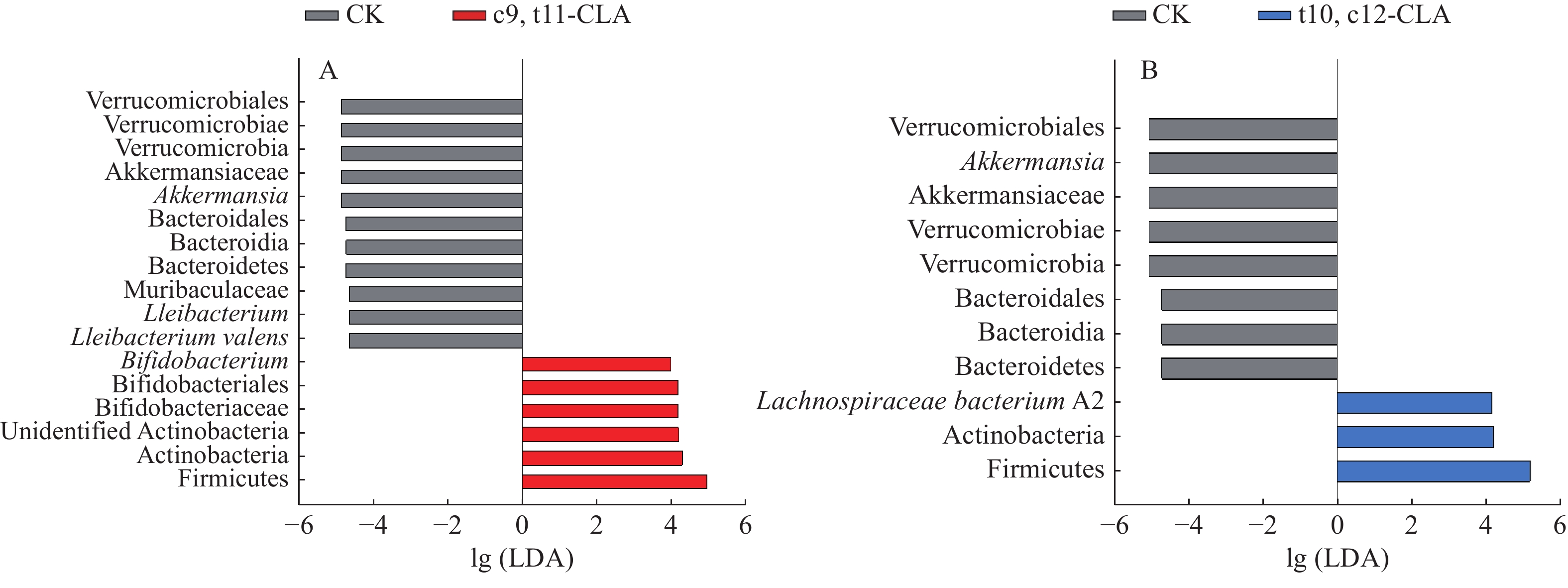
从Lefse分析可知,c9, t11-CLA可上调小鼠放线菌门Actinobacteria以及目、科、属3个水平的双歧杆菌(Bifidobacteriales、Bifidobacteiaceae、Bifidobacterium)丰度。此外,c9, t11-CLA可上调拟杆菌门的Bacteroidates、 Bacteroidia、Bacteroidales 和 Muribaculaceae丰度,下调疣微菌门的Verrucomicrobia、Akkermansia以及厚壁菌门的Ileibacterium丰度(图6A)。
|
图 6 2种共轭亚油酸异构体对小鼠肠道微生物(LDA)的影响 Fig. 6 Effects of two conjugated linoleic acid isomers on gut microflora(LDA score) in mice |
t10, c12-CLA可上调拟杆菌门的Lachnospiraceae bacterium A2和放线菌门Actinobacteria丰度,下调门、纲、目3个水平的拟杆菌(Bacteroidates、Bacteroidia、Bacteroidales)和疣微菌(Verrucomicrobia、Verrucomicrobiae、Verrucomicrobialea)丰度(图6B)。
3 讨论与结论 3.1 2种共轭亚油酸异构体对小鼠脂肪沉积的影响脂肪过度沉积引起肥胖,在人类健康和畜禽生产中均会产生不良影响。共轭亚油酸(CLA)作为功能性脂肪酸,已有多项研究发现其可在机体代谢中发挥功能性的调控作用,如抗癌、抗高血压和调节机体免疫反应等[16]。本研究在普通日粮中分别添加c9, t11-CLA和t10, c12-CLA饲喂小鼠,结果发现,2种CLA均能显著降低小鼠体质量和脂肪含量。目前也有多项研究表明CLA具有减脂作用。例如,给肥胖(db/db)小鼠灌胃CLA一段时间后,可显著降低小鼠体质量和采食量[17];在给小鼠饲喂共轭亚油酸不同异构体研究中也发现,t10, c12-CLA能降低小鼠白色脂肪含量[18],c9, t11-CLA能降低仓鼠脂肪沉积[19],这与我们的研究结果一致,即2种CLA异构体均能降低小鼠脂肪沉积。
3.2 2种共轭亚油酸异构体降低小鼠脂肪沉积与能量代谢有关大量研究表明共轭亚油酸具有降低机体脂肪沉积的作用,但其降脂的具体调节机制仍值得探究。能量代谢可促进脂质代谢,减少脂肪含量,因此,我们进行了小鼠代谢笼试验,监测小鼠的新陈代谢。结果显示,c9, t11-CLA和t10, c12-CLA均显著增加小鼠的耗氧量和产热量。耗氧和产热均能促进脂肪代谢,因此,2种CLA异构体可能通过促进小鼠产热降低小鼠体质量。此前的研究也发现,日粮中添加CLA能促进小鼠褐色脂肪和白色脂肪中解偶联蛋白−2(UCP-2)的mRNA和蛋白表达,而UCP-2能增加能量消耗,与脂肪代谢和能量调控密切相关[20-21]。也有研究发现日粮中添加CLA能显著增加小鼠白色脂肪中CPT-1和UCP-1的表达,进而促进脂肪代谢[22-23]。其中,t10, c12-CLA显著降低RER值(当RER值为0.7时,机体的供能全部来源于脂肪;RER值为1时,机体的供能全部来源于葡萄糖),表明t10, c12-CLA能显著促进机体对脂肪的消耗,而c9, t11-CLA对RER无显著影响。Park等[24]的研究也表明,与富含c9, t11-CLA的饮食相比,摄入富含t10, c12-CLA的饮食可以显著降低体内脂肪含量。综上所述,2种CLA异构体均能促进小鼠能量代谢,因此共轭亚油酸减脂作用可能与能量代谢有关。
3.3 2种共轭亚油酸异构体降低小鼠脂肪沉积与肠道微生物有关由上文可知,日粮添加c9, t11-CLA和t10, c12-CLA可能通过促进能量代谢,降低小鼠体质量。大量文献报道,肠道微生物是机体重要的微生态系统,能参与调控机体多项代谢过程。因此,我们对小鼠盲肠内容物进行了微生物分析。结果显示,c9, t11-CLA和t10, c12-CLA均能改变小鼠的肠道微生物结构,促进与新陈代谢相关的菌群丰度,且t10, c12-CLA能促进与脂质代谢相关的菌群丰度;c9, t11-CLA可上调小鼠放线菌门Actinobacteria以及目、科、属3个水平的双歧杆菌(Bifidobacteriales、Bifidobacteiaceae、Bifidobacterium)丰度。有研究发现,Actinobacteria和双歧杆菌能促进机体能量代谢和降低脂肪含量[25-27]。此外,c9, t11-CLA可下调疣微菌门的Verrucomicrobia、Akkermansia以及厚壁菌门的Ileibacterium丰度。值得注意的是,有研究表明在高脂和肥胖模型中,Akkermansia和Ileibacterium丰度均与脂肪沉积呈负相关[28-30],这与我们的结果不一致,可能是由于模型不同导致的。
t10, c12-CLA也可上调放线菌门Actinobacteria丰度,下调门、纲、目3个水平的拟杆菌(Bacteroidates、Bacteroidia、Bacteroidales)和疣微菌(Verrucomicrobia、Verrucomicrobiae、Verrucomicrobialea)丰度。值得注意的是,2种单体均能上调厚壁菌丰度,降低拟杆菌丰度,使厚壁菌与拟杆菌比值增加(肠内厚壁菌多于拟杆菌,能更有效吸收食物中的热量从而导致肥胖)[31]。由上可知,CLA能上调促进脂质代谢的肠道微生物丰度,改变菌群结构。因此,2种CLA异构体减少脂肪沉积可能与改变肠道微生物菌群结构有关。
肠道微生物和能量代谢密切相关。肠道微生物分析结果表明,c9, t11-CLA和t10, c12-CLA均能显著上调与新陈代谢相关的菌群丰度。Lee等[32]表明肠道微生物能改变机体能量代谢。c9, t11-CLA和t10, c12-CLA均显著上调放线菌门菌群丰度,也有研究发现放线菌能促进机体能量代谢[25]。因此,2种CLA异构体提高能量代谢可能与改变肠道微生物菌群结构有关。
综上所述,日粮添加c9, t11-CLA或t10, c12-CLA,可显著降低小鼠脂肪沉积,而这可能与CLA促进机体能量代谢和改变肠道微生物菌群结构有关。
| [1] |
ARROYO-JOHNSON C, MINCEY K D. Obesity epidemiology worldwide[J]. Gastroenterology clinics of North America, 2016, 45(4): 571-579. DOI:10.1016/j.gtc.2016.07.012 (  0) 0) |
| [2] |
SILVESTRIS E, DE PERGOLA G, ROSANIA R, et al. Obesity as disruptor of the female fertility[J]. Reproductive Biology and Endocrinology:RB&E, 2018, 16(1): 22. DOI:10.1186/s12958-018-0336-z ( 0) |
| [3] |
NADERPOOR N, SHORAKAE S, JOHAM A, et al. Obesity and polycystic ovary syndrome[J]. Minerva Endocrinologica, 2015, 40(1): 37-51. ( 0) |
| [4] |
BRAY G A, KIM K K, WILDING J P H, et al. Obesity: A chronic relapsing progressive disease process. A position statement of the World Obesity Federation[J]. Obesity Reviews: An Official Journal of the International Association for the Study of Obesity, 2017, 18(7): 715-723. DOI:10.1111/obr.12551 ( 0) |
| [5] |
KIM S W, WEAVER A C, SHEN Y B, et al. Improving efficiency of sow productivity: Nutrition and health[J]. Journal of Animal Science and Biotechnology, 2013, 4(1): 26. DOI:10.1186/2049-1891-4-26 ( 0) |
| [6] |
PARIZA M W, PARK Y, COOK M E. The biologically active isomers of conjugated linoleic acid[J]. Progress in Lipid Research, 2001, 40(4): 283-298. DOI:10.1016/S0163-7827(01)00008-X ( 0) |
| [7] |
KOBA K, AKAHOSHI A, YAMASAKI M, et al. Dietary conjugated linolenic acid in relation to CLA differently modifies body fat mass and serum and liver lipid levels in rats[J]. Lipids, 2002, 37(4): 343-350. DOI:10.1007/s11745-002-0901-7 ( 0) |
| [8] |
RYDER J W, PORTOCARRERO C P, SONG X M, et al. Isomer-specific antidiabetic properties of conjugated linoleic acid: Improved glucose tolerance, skeletal muscle insulin action, and UCP-2 gene expression[J]. Diabetes, 2001, 50(5): 1149-1157. DOI:10.2337/diabetes.50.5.1149 ( 0) |
| [9] |
LEHNEN T E, DA SILVA M R, CAMACHO A, et al. A review on effects of conjugated linoleic fatty acid (CLA) upon body composition and energetic metabolism[J]. Journal of the International Society of Sports Nutrition, 2015, 12: 36. DOI:10.1186/s12970-015-0097-4 ( 0) |
| [10] |
伏春燕, 张燕, 魏祥法, 等. 共轭亚油酸降低脂肪沉积的分子机制研究进展[J]. 动物营养学报, 2019, 31(8): 3456-3462. ( 0) |
| [11] |
BIRSOY K, FESTUCCIA W T, LAPLANTE M. A comparative perspective on lipid storage in animals[J]. Journal of Cell Science, 2013, 126(Pt 7): 1541-1552. ( 0) |
| [12] |
SHREINER A B, KAO J Y, YOUNG V B. The gut microbiome in health and in disease[J]. Current Opinion in Gastroenterology, 2015, 31(1): 69-75. DOI:10.1097/MOG.0000000000000139 ( 0) |
| [13] |
CHO I, BLASER M J. The human microbiome: At the interface of health and disease[J]. Nature Reviews Genetics, 2012, 13(4): 260-270. DOI:10.1038/nrg3182 ( 0) |
| [14] |
WALDRAM A, HOLMES E, WANG Y, et al. Top-down systems biology modeling of host metabotype-microbiome associations in obese rodents[J]. Journal of Proteome Research, 2009, 8(5): 2361-2375. DOI:10.1021/pr8009885 ( 0) |
| [15] |
FEI N, ZHAO L. An opportunistic pathogen isolated from the gut of an obese human causes obesity in germfree mice[J]. The ISME Journal, 2013, 7(4): 880-884. DOI:10.1038/ismej.2012.153 ( 0) |
| [16] |
刘丽娜, 缪锦来, 郑洲. 共轭亚油酸的生理功能综述[J]. 食品安全质量检测学报, 2020, 11(8): 2552-2557. ( 0) |
| [17] |
夏珺, 郑明月, 李灵杰, 等. 共轭亚油酸改善肥胖糖尿病小鼠的糖脂代谢[J]. 南方医科大学学报, 2019, 39(6): 740-746.
( 0) |
| [18] |
LAROSA P C, RIETHOVEN J J, CHEN H, et al. Trans-10, cis-12 conjugated linoleic acid activates the integrated stress response pathway in adipocytes[J]. Physiological Genomics, 2007, 31(3): 544-553. DOI:10.1152/physiolgenomics.00156.2007 ( 0) |
| [19] |
VALEILLE K, FÉRÉZOU J, AMSLER G, et al. A cis-9, trans-11-conjugated linoleic acid-rich oil reduces the outcome of atherogenic process in hyperlipidemic hamster[J]. American Journal of Physiology Heart and Circulatory Physiology, 2005, 289(2): H652-H659. DOI:10.1152/ajpheart.00130.2005 ( 0) |
| [20] |
TSUBOYAMA-KASAOKA N, TAKAHASHI M, TANEMURA K, et al. Conjugated linoleic acid supplementation reduces adipose tissue by apoptosis and develops lipodystrophy in mice[J]. Diabetes, 2000, 49(9): 1534-1542. DOI:10.2337/diabetes.49.9.1534 ( 0) |
| [21] |
EALEY K N, EL-SOHEMY A, ARCHER M C. Effects of dietary conjugated linoleic acid on the expression of uncoupling proteins in mice and rats[J]. Lipids, 2002, 37(9): 853-861. DOI:10.1007/s11745-002-0971-6 ( 0) |
| [22] |
LAROSA P C, MINER J, XIA Y, et al. Trans-10, cis-12 conjugated linoleic acid causes inflammation and delipidation of white adipose tissue in mice: A microarray and histological analysis[J]. Physiological Genomics, 2006, 27(3): 282-294. DOI:10.1152/physiolgenomics.00076.2006 ( 0) |
| [23] |
MARTIN J C, GRÉGOIRE S, SIESS M H, et al. Effects of conjugated linoleic acid isomers on lipid-metabolizing enzymes in male rats[J]. Lipids, 2000, 35(1): 91-98. DOI:10.1007/s11745-000-0499-9 ( 0) |
| [24] |
PARK Y, STORKSON J M, ALBRIGHT K J, et al. Evidence that the trans-10, cis-12 isomer of conjugated linoleic acid induces body composition changes in mice[J]. Lipids, 1999, 34(3): 235-241. DOI:10.1007/s11745-999-0358-8 ( 0) |
| [25] |
BINDA C, LOPETUSO L R, RIZZATTI G, et al. Actinobacteria: A relevant minority for the maintenance of gut homeostasis[J]. Digestive and Liver Disease: Official Journal of the Italian Society of Gastroenterology and the Italian Association for the Study of the Liver, 2018, 50(5): 421-428. ( 0) |
| [26] |
TEIXEIRA T F S, GRZEŚKOWIAK L M, SALMINEN S, et al. Faecal levels of Bifidobacterium and Clostridium coccoides but not plasma lipopolysaccharide are inversely related to insulin and HOMA index in women[J]. Clinical Nutrition, 2013, 32(6): 1017-1022. DOI:10.1016/j.clnu.2013.02.008 ( 0) |
| [27] |
GEURTS L, NEYRINCK A M, DELZENNE N M, et al. Gut microbiota controls adipose tissue expansion, gut barrier and glucose metabolism: Novel insights into molecular targets and interventions using prebiotics[J]. Beneficial Microbes, 2014, 5(1): 3-17. DOI:10.3920/BM2012.0065 ( 0) |
| [28] |
DEN HARTIGH L J, GAO Z, GOODSPEED L, et al. Obese mice losing weight due to trans-10, cis-12 conjugated linoleic acid supplementation or food restriction harbor distinct gut microbiota[J]. The Journal of Nutrition, 2018, 148(4): 562-572. DOI:10.1093/jn/nxy011 ( 0) |
| [29] |
DAO M C, EVERARD A, ARON-WISNEWSKY J, et al. Akkermansia muciniphila and improved metabolic health during a dietary intervention in obesity: Relationship with gut microbiome richness and ecology[J]. Gut, 2016, 65(3): 426-436. DOI:10.1136/gutjnl-2014-308778 ( 0) |
| [30] |
DEPOMMIER C, VAN HUL M, EVERARD A, et al. Pasteurized Akkermansia muciniphila increases whole-body energy expenditure and fecal energy excretion in diet-induced obese mice[J]. Gut Microbes, 2020, 11(5): 1231-1245. DOI:10.1080/19490976.2020.1737307 ( 0) |
| [31] |
MOKKALA K, HOUTTU N, CANSEV T, et al. Interactions of dietary fat with the gut microbiota: Evaluation of mechanisms and metabolic consequences[J]. Clinical Nutrition, 2020, 39(4): 994-1018. DOI:10.1016/j.clnu.2019.05.003 ( 0) |
| [32] |
LEE C J, SEARS C L, MARUTHUR N. Gut microbiome and its role in obesity and insulin resistance[J]. Annals of the New York Academy of Sciences, 2020, 1461(1): 37-52. DOI:10.1111/nyas.14107 ( 0) |